
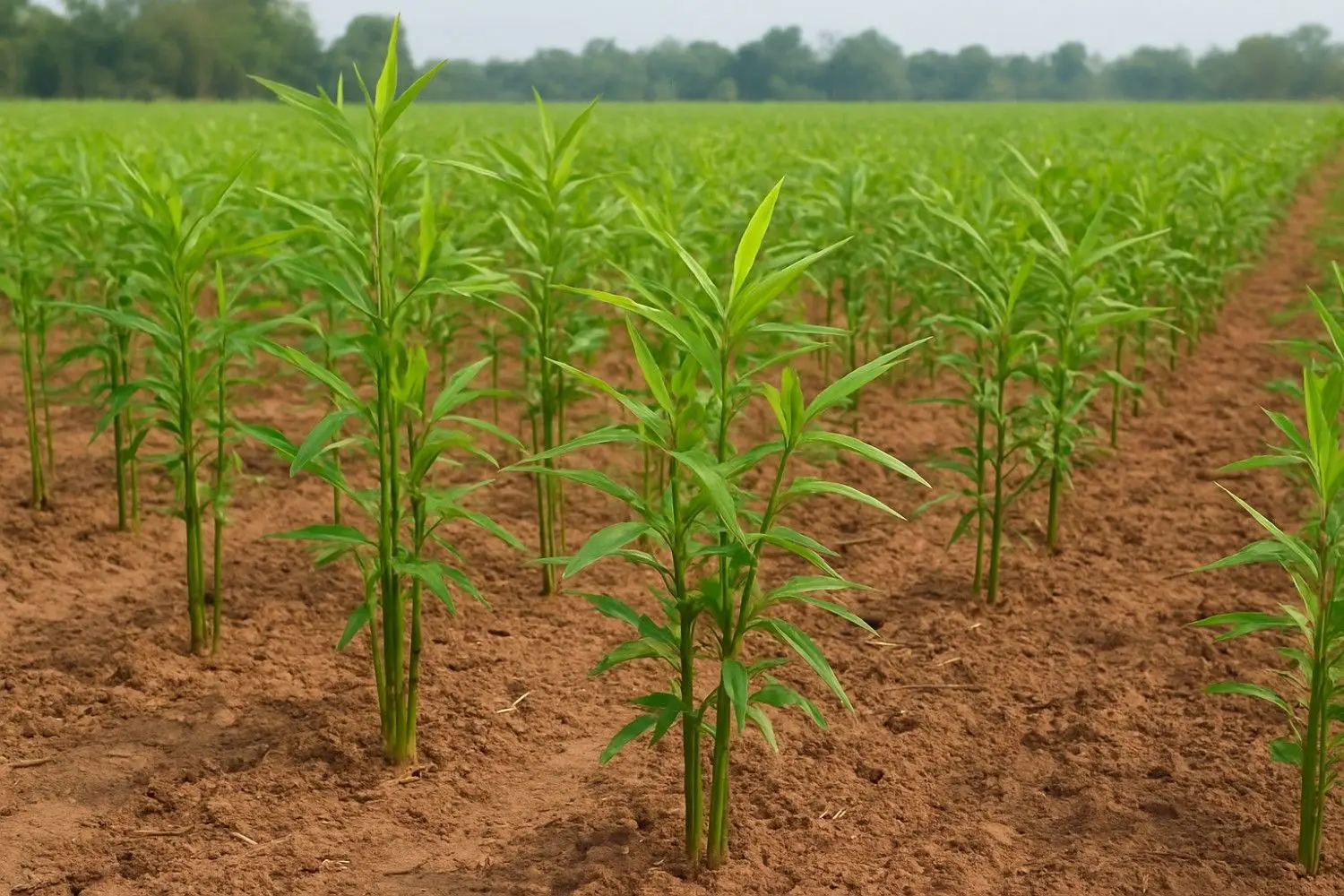
Introduction to Bamboo
Bamboo, scientifically classified under the subfamily Bambusoideae, is one of the most remarkable plants in the world. Unlike trees, bamboo is a perennial grass, yet it can grow as tall and strong as timber. Globally, there are 110 genera and over 1,500 species, with India contributing 23 genera and 136 species, most of which thrive in the northeastern states. In Africa, Ethiopia’s lowland bamboo (Oxytenanthera abyssinica) is equally significant, dominating dry zones and sustaining rural livelihoods.
What sets bamboo apart is its growth speed – some species can grow up to 1 meter per day, making it one of the fastest-growing plants on earth. Its culms reach maturity in 3–5 years, much faster than traditional timber, which can take decades. This regenerative power makes bamboo an ideal candidate for sustainable forestry, climate-smart agriculture, and green industries.

Importance and Benefits of Bamboo
Bamboo has earned the name “Green Gold” because of its immense environmental, social, and economic benefits.
Environmental Benefits:
- Acts as a natural carbon sink, absorbing up to 12 tonnes of CO₂ per hectare annually.
- Prevents soil erosion on slopes due to its dense root and rhizome network.
- Improves soil fertility through leaf litter, which enriches organic matter.
- Restores degraded lands, particularly wastelands, marginal farms, and riverbanks.
Livelihood and Social Benefits:
- Over 600 million people worldwide depend on bamboo for income.
- Provides raw material for cottage industries like basket weaving, mat making, and handicrafts, often supporting women and rural artisans.
- Serves as a food source—young bamboo shoots are edible, nutritious, and form part of Asian cuisine.
Economic Benefits:
- Bamboo’s global trade covers construction, furniture, textiles, flooring, paper pulp, and bioenergy.
- Its fast regeneration ensures continuous income cycles for farmers.
- In India, bamboo has been reclassified as an agricultural crop, enabling farmers to grow and sell it freely without restrictive forest laws.
Varieties of Bamboo
Bamboo is broadly divided into two growth types:
- Sympodial (clump-forming bamboo): Short rhizomes that form dense clusters. Common in tropical regions.
- Monopodial (running bamboo): Long rhizomes that spread underground. Common in temperate regions.
Key Commercial Bamboo Species in India
- Bambusa bambos – Tall (30 m), widely grown, used for pulp, handicrafts, construction, and edible shoots.
- Bambusa balcooa – Known as “Bhima bamboo,” valued for strength and used in furniture, agarbathi sticks, and structural work.
- Dendrocalamus asper – “Sweet bamboo,” famous for edible shoots and poles.
- Dendrocalamus strictus – Widely cultivated in central India, used for pulp, furniture, and musical instruments.
- Melocanna baccifera – Common in the northeast, produces edible seeds, used in weaving.
Ethiopian Lowland Bamboo
- Oxytenanthera abyssinica – Clump-forming, solid-stemmed bamboo that grows 3–10 m tall. Culms are used for basketry, mats, bioenergy, and animal fodder. Thrives in semi-arid regions with 700–1000 mm rainfall, showing its resilience under harsh conditions.
Climatic and Soil Requirements
Bamboo is highly adaptable, but optimal growth requires specific conditions:
- Temperature: Ideal range is 20–35°C. Some species tolerate up to 40°C, while highland species prefer cooler climates.
- Rainfall: Requires 1000–2500 mm annually, though species like O. abyssinica survive in semi-arid areas with 700 mm.
- Altitude: Ranges from sea level to 1,500 m, depending on species.
- Soil: Prefers well-drained sandy loam to clay loam soils. Avoid waterlogged and saline soils.
- pH: Between 5.5 and 6.5 for most species.
Land Preparation
The National Bamboo Mission (NBM) recommends utilising remote sensing and GIS mapping to identify wasteland areas suitable for bamboo plantations.
Steps for preparation:
- Clearing: Remove weeds, shrubs, and unwanted vegetation.
- Ploughing: Deep ploughing ensures aeration and root penetration.
- Pit digging: Standard pits are 60 × 60 × 60 cm, filled with soil and organic manure.
- Spacing: Varies by species – 5 × 5 m for clump-forming varieties, 7 × 7 m for larger species like D. giganteus.
Propagation and Planting Methods
Bamboo propagation is done either by seeds (rare) or vegetative means (preferred).
1. Seed Propagation
- Seeds have low viability (a few weeks to months). Must be sown immediately after collection.
- Nursery-raised seedlings are transplanted after 8–12 months.
2. Vegetative Propagation
- Offsets: Traditional method where rhizomes with culms are transplanted. Effective but labour-intensive.
- Culm and branch cuttings: Cheaper and suitable for large-scale plantations.
- Tissue culture: Recommended for producing disease-free, large-scale planting material.
3. Nursery Establishment
- Hi-tech nurseries with tissue culture labs can produce up to 50,000 seedlings per ha/year.
- Proper irrigation, shading, composting units, and greenhouses ensure high survival rates.
Planting Time
Best during monsoon (June–July) in rainfed areas or throughout the year with irrigation support.
Irrigation and Nutrient Management
- Irrigation: Young plantations require watering every 7–10 days. Micro-irrigation systems improve efficiency. Ethiopian nurseries recommend daily watering for seedlings.
- Nutrients: Apply 10–12 tonnes FYM/ha at planting. Recommended chemical fertiliser: NPK 150:100:150 kg/ha/year in 2–3 split doses.
- Mulching: Conserves soil moisture, improves fertility, and suppresses weeds.
Intercropping and Agroforestry Uses
Bamboo integrates seamlessly into agroforestry systems:
- It can be combined with crops like ginger, turmeric, beans, and pulses.
- Acts as a windbreak and soil stabiliser, making it ideal for erosion-prone regions.
- Provides shade and microclimate benefits for companion crops.
Pest and Disease Management
Bamboo faces threats from insects, fungi, and borers.
- Pests: Termites, shoot borers, and defoliators are common.
- Diseases: Fungal infections during storage can damage culms.
- Management:
- Regular clump cleaning and thinning.
- Application of preservatives to extend culm durability beyond 50 years.
- Use of eco-friendly biopesticides where possible.
Harvesting Techniques
- Culms mature in 3–5 years, depending on the species.
- Only mature culms are cut, leaving younger ones to ensure sustainability.
- Ethiopian guidelines recommend selective cutting—removing 3-year-old culms while leaving younger and older ones to maintain clump vigour.
- Harvesting should be done with sharp tools, cutting just above the second node.
Yield and Post-Harvest Management
- Yield:
- Bambusa balcooa and D. asper: 50 tonnes/ha/year.
- Ethiopian lowland bamboo (O. abyssinica): Culms ready within 3 years, providing continuous raw material.
- Post-harvest handling:
- Drying and seasoning to reduce moisture.
- Chemical/biological preservatives to prevent decay and insect attack.
- Proper storage in warehouses near villages reduces transportation losses.
Economic Importance and Market Potential

Bamboo’s economic potential is vast:
- Construction industry: Flooring, scaffolding, panels, engineered bamboo.
- Pulp and paper: A renewable substitute for wood pulp.
- Handicrafts and furniture: High-value products with export potential.
- Food industry: Bamboo shoots are a multi-million dollar global trade commodity.
- Energy: Bamboo can be used for biomass and charcoal.
In India, the National Bamboo Mission (NBM) promotes bamboo cultivation through subsidies for nurseries, plantations, irrigation, and processing units. Bamboo is also listed on e-NAM, allowing farmers to sell produce directly in national markets.
Conclusion: The Future is Bamboo
Bamboo is more than just a plant – it is a renewable resource, a livelihood generator, and an ecological protector. From the humid forests of India to the dry savannas of Ethiopia, bamboo has proven its adaptability and profitability.
With rising demand for eco-friendly products, bamboo cultivation offers farmers a chance to diversify income, industries to innovate, and communities to build resilience against climate change.
As governments, industries, and farmers embrace bamboo, it truly stands as the “Green Gold” of sustainable agriculture and the bioeconomy of the future.
Connect with Us.
We truly value your interest and look forward to connecting with you. Whether you have questions, need tailored solutions, or wish to explore collaboration, we are here to help. Reach out today — our team is ready to provide expert guidance and meaningful support. Wishing you a bountiful and prosperous bamboo cultivation! For further assistance or any queries E-mail us, please feel free to reach us at @ Agrigo 24/7
Reference
https://www.unido.org/sites/default/files/2010-01/Guidelines_for_cultivating_Ethiopian_lowland_bamboo_0.pdf
https://www.niti.gov.in/sites/default/files/2023-08/Technical_Session_1_Commercial_Bamboo_Varieties_and_their_production_in_the_different_states_of_India_Shri_Syed_Salim.pdf
https://nbm.da.gov.in/Documents/pdf/NBM_Revised_Guidelines.pdf
Leave a Reply