
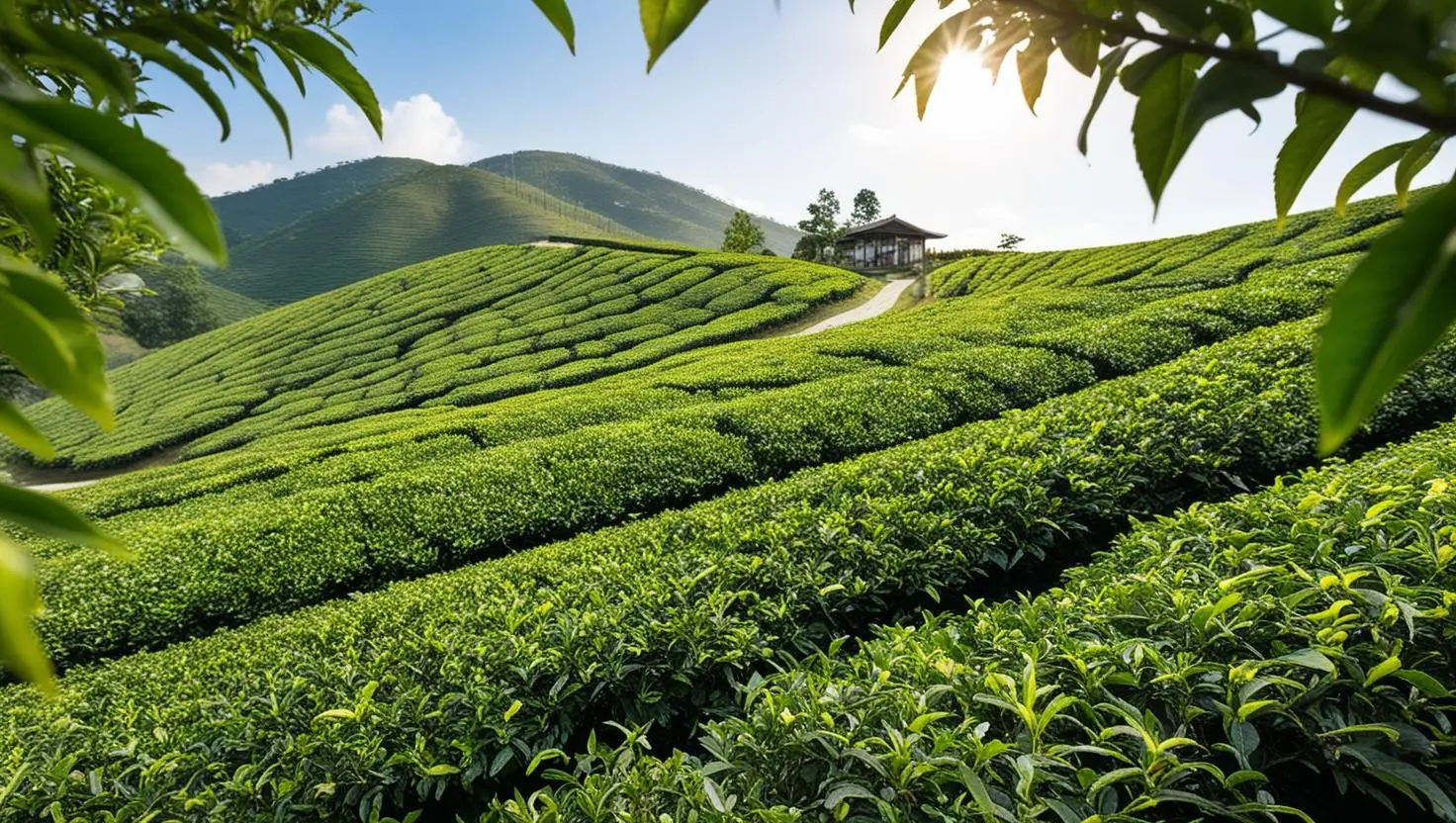
The tea plant is an aromatic shrub species of the evergreen and flowering family, Theaceae. The leaves, buds, and stems are used to produce tea. The leaves contain about 4% caffeine.


The tea plant is used to make tea, tea tree oil, and tea tree cake (as fish toxicants) and for many purposes. Tea is the oldest-known beverage and is native to South East China. India is now the leading producer, consumer and exporter in the tea industry. Tea plantations came into India back in the 19th century when the British army noticed a popular drink among the Singpo tribe in Assam, which later was discovered as a drink from tea plants.
Varieties of Tea Plant
The original tea species of India were Camellia assamica (Assam jat) and C. sinesis (China jat). But presently tea plants are highly cross-pollinated and have produced many varieties.
| Improved Clones | |
| Clone | Important Features |
| UPASI 1 (Evergreen) | Hardy, Quality-Above average |
| UPASI 2 (Jayaram) | Hardy, Quality-Above average, tolerant to drought and wind |
| UPASI 3 (Sundaram) | Natural triploid quality clones and very high-yielding |
| UPASI 6 (Brooklands) | Suited to mid and higher elevations |
| UPASI 8 (Golconda) | Suited to all elevations, high-yielding |
| UPASI 9 (Arthrey) | Fairly tolerant to drought and withstand slightly high pH, high-yielding |
| UPASI 10 (Pandian) | Hardy, Quality-Above average, tolerant to drought and wind |
| UPASI 14 (Singara) | Suited to higher elevations, High yield |
| UPASI 15 (Spring field) | Flushes throughout the year |
| UPASI 17 (Swarna) | Flourishing well at mid and high elevations |
| UPASI 24 | Hardy |
| UPASI 25 | High yielding |
| UPASI 16 | High yielding |
| UPASI 27 | Drought tolerant |
| UPASI 28 (UPASI 10 * TRI2025) | Biclonal, Good strength and high quality |
Now let’s see how to grow this lush, evergreen plantation.
Tea Plantation: How To Do It?
As we move forward to learn how to have a successful tea plantation, let’s start with knowing about the ideal growing conditions of a tea plant.
Growing Parameters
- Soil: Well-drained soil with high organic matter
- Elevation: 1000-2500m
- pH: 4.5 – 5.5
- Temperature: 16-32 degree Celsius
- Annual Rainfall: 90-750cm
- Relative Humidity: 80%
Tea Propagation and Polyethene Sleeves
Tea seeds germinate in 4-6 weeks and the cracked seeds are transplanted in polythene sleeves. To prepare use polythene sleeves (150 or 200 gauge) of 10 cm width and 30-45 cm length and provide drainage holes at the bottom. Now fill the lower 3/4 of the sleeves with a 1:3 sand-soil mixture and the top 1/4 with a 1:1 sand-soil mixture. Lastly, arrange in rows and provide overhead shade.
Selection and Treatment of Mother Bushes
After transplantation, choose healthy, vigorously growing, high-yielding bushes and apply 40 g of young tea mixture and 60:90 NK mixture to each selected bush for up to 5 years. Before taking cuttings, you should treat the bushes as follows:
- 0.5% AlSO4 + 1% MgSO4 (3 weeks prior)
- 2% ZnSO4 (2 weeks prior)
- 1% Urea (1 week prior)
Tea Cuttings Preparation
Tea plant cuttings are taken in April-May and August-September. Prepare semi-hardwood cuttings using one leaf and an internode, making a slanting cut at the base.
Plantation Of Cuttings
Firstly, water the sleeves thoroughly and create holes in the soil. Then, insert the cuttings into the holes, pressing the soil firmly around them to eliminate air pockets, then water again. To maintain high humidity and regulate temperature, use small polythene. Cuttings typically take 10-12 weeks to root. After 90 days, when all cuttings have rooted, gradually remove the polythene tents for 10-15 days.
Nutrient Application In Nursery Plantation
To get a high-yield nutrient application in the nursery plantation itself. Dissolve 30g of tea nursery mixture in 10 liters of water and spray over 2m sq. (450 plants) at weekly intervals. The composition of the mixture is as follows:
| Ammonium phosphate (20:20) | 60 parts |
| Potassium Sulphate | 24 parts |
| (or) Muriate of Potash | 20 parts |
| Magnesium Sulphate | 16 parts |
Cultivation Field Preparation
Preparation of Field
New Planting: To prevent root diseases, remove as much of the root system as possible after felling trees. Clear the jungle growth, but do not burn it, as the ash will raise the pH due to its alkalinity.
Replanting: For replanting, remove old Grevillea (silver oak) trees by ring barking, but leave the young ones. Level the land to an even slope to facilitate easy cultural operations and ensure proper drainage.
Planting Style
| Up and Down | 1.2m x 1.2m (6800 plants/ha) |
| Contour planting, single hedge | 1.2m x 0.75m (10,800 plants/ha) |
| Contour planting, double hedge | 1.35m x 0.75m x 0.75m (13200 plants/ha) |
Double hedge planting allows for more plants per unit area. It offers several benefits, including early high yields, improved soil conservation, reduced weed growth, efficient cultural practices, and better supervision.
Pitting
Dig pits 30 x 45 cm, keeping the top and bottom soil separate. In clayey or drought-prone areas, deeper pits (60 cm) or trench planting are more beneficial.
Planting Seasons
Southwest monsoon areas: June-July
Northeast monsoon areas: September-October
Planting
If the soil pH exceeds 5.5, mix 100 g of powdered aluminium sulphate per pit with the soil. Choose seedlings that are 12 months old. After planting, compact the soil around the seedlings and apply mulch at a rate of 25 t/ha, keeping the mulch away from the plant’s collar region by placing a peg above the plant on the slope. If mulch material is scarce, consider raising an intercrop or cover crop.
Main Field Nutrient Application
Commence the manuring of young tea plants after 2 months of planting.
The rate of fertilizers of soil with 5.5 pH is:
| Age | N: K2O kg/ha/annum | No. of splits |
| 1st year | 180: 270 | 5 |
| 2nd year | 240: 360 | 6 |
| 3rd year | 340: 450 | 6 |
| 4th year & above | 300:300 | 6 |
Also, apply phosphorus at 90kg/ha every year in one application.
Method of Application: Apply the recommended fertilizer mixtures along the drip circle of the plants. Use the Kokra-eyebrow method to create a semi-circular furrow above the plant on the slope. Apply fertilizers when the soil has adequate moisture and the fields are weed-free. Punch 15-22 cm deep holes in the soil on either side of the plants and place the rock phosphate in these holes.
Training of Young Tea
Proper training of young tea bushes is essential for encouraging a good spread, proper frame development, and a high density of plucking points. Three to four months after planting, cut off the leader stem to arrest apical dominance, a process called centring, which promotes the growth of axillary buds and lateral branches. To further promote lateral branch formation and establish a good plucking surface, perform two-stage tipping: the first tipping at 35 cm and the second at 50 cm.
Formative pruning is carried out five years after planting to aid in branch formation. The recommended height for this pruning is around 45 cm, removing branches thinner than a pencil.
Centring
To arrest apical dominance and induce secondary branch growth, cut the leader stem with secateurs, leaving 8-10 mature leaves below the cut. Ensure proper recovery. Perform centring 4-6 months after planting during humid weather when the soil has adequate moisture.
Tipping
The first plucking of the periodic shoot should be done after centring or pruning. Two-tier tipping ensures proper spread: the first tipping at 35 cm height induces tertiary branches, and the second tipping at 50 cm height increases the density of plucking points. Tipping should be performed on green, semi-hardwood branches, specifically on shoots with 3-4 leaves and a bud.
Plucking
Mother-leaf or step-up plucking is practiced during lean seasons, while level plucking is done during high cropping months to ensure better frame development.
Shade Management
The best permanent shade tree for tea plantations in South India is the silver oak (Grevillea robusta).
Planting Silver Oak
Silver oak can be propagated from seeds, which should be sown within 6 months of collection. Sow seeds in raised beds, 1 m wide and of convenient length, using sandy loam soil with a pH of around 6.0. Cover seeds with a thin layer of sand or ash. Germination occurs in 2-3 weeks. Use 6-9 month-old seedlings for planting, spaced 6 x 6 m (275 plants/ha) along tea rows. Prior to planting, mix 100 g of rock phosphate and 400 g of dolomite per pit with the soil. Apply 100 g of NK mixture per tree twice a year, 250 g of rock phosphate and 1.1 kg of borated lime (1 kg dolomite + 100 g boric acid) per tree every alternate year.
Shade Regulation
Tea requires sparse shade. Maintain optimal shade density based on tree growth, garden altitude, and field aspect (south and west slopes need more shade). Thin shade to 12 x 6 m spacing after 8-10 years and further to 12 x 12 m after 12 years if needed. Always thin shade before pruning.
Pollarding and Annual Lopping
Pollarding involves cutting the main stem to develop lateral branches. Start pollarding when trees reach a girth of around 50 cm at elbow height. Pollarding height depends on altitude: 8 m for high altitudes and 9 m for lower elevations. Leave one branch in each direction and 3-4 tiers of branches below the pollarding height.
Lopping involves cutting the erect branches on the laterals before the monsoon, retaining only the lateral branches.
Shade Removal
The useful life span of Grevillea is 40-60 years. Remove old trees after establishing new shade.
Temporary Shade
For frost-prone areas, use Acacia mearnsii. For mid-elevations, use Indigofera teysmanii. For higher altitudes, use Sesbania cinerescens, Crotalaria agathiflora, and Acacia elata. Plant temporary shade trees at 3 x 3 m spacing. Remove temporary shade after Grevillea is established, typically after 3 years.
Pruning
| Type of Pruning | Season | Height |
| Rejuvenation | April/May | <30cm |
| Hard Pruning | April/May | 30-45cm |
| Medium Pruning | August/September | 45-60cm |
| Light Pruning | August/September | 60-65cm |
| Skiffing | October | >65cm |
Post Pruning
After rejuvenation and hard pruning apply copper oxychloride or sulphur + linseed oil (1:1) to large cut-ends.
Pests Control
- Nematodes (Meloidogyne spp.):
– Symptoms: Galls on roots, nutrient deficiency, stunted growth.
– Control: Heat treat nursery soil, and apply neem cake (2 kg per bush).
- White/Cockchafer Grubs (Holotrichia sp.):
– Symptoms: Root damage, chlorosis, defoliation.
– Control: Heat treat nursery soil, drench Chlorpyriphos or Quinalphos (0.05%).
- Root Mealy Bug (Dysmicoccus sp.):
– Symptoms: Sap-sucking on roots, mother-leaf fall.
– Control: Proper soil management.
- Stem Borers:
– Red Coffee Borer (Zeuzera coffeae):* Symptoms: Bored stems, frass around plants.
– Large Hepialid Borer (Sahyadrassus malabaricus):* Symptoms: Thick branch infestation.
– Control: Cut affected stems, and treat with Quinalphos.
- Mites:
– Pink Mite (Acaphylla theae):* Symptoms: Pale, curled leaves, brown discolouration.
– Scarlet Mite (Brevipalpus australis):* Symptoms: Brown discolouration, defoliation.
– Red Spider Mite (Oligonychus coffeae):* Symptoms: Bronze foliage, defoliation.
– Control: Apply Quinalphos, use biocontrol fungi.
- Tea Thrips (Scirtothrips bispinosus):
– Symptoms: Streaked leaves, curled margins.
– Control: Use yellow sticky traps, spray Verticillium lecanii.
- Tea Mosquito Bug (Helopeltis theivora):
– Symptoms: Punctured plant tissues, deformed leaves.
– Control: Monitor infestation, apply Quinalphos, chlorpyrifos.
General Control:
– Monitor pests regularly.
– Use cultural, biological, and chemical control methods as needed.
Diseases Control
- Root Diseases
- Black Root Disease (Rosellinia arcuata):
– Symptoms: Black, woolly mycelium on roots, girdling at collar, star-shaped mycelium on wood.
– Control: Remove surface mulches (10m), drench soil with Dithane M 45 or Captan, use biocontrol agents (Trichoderma or Gliocladium, 200g/pit).
2.Red Root Disease (Poria hypolateritia):
– Symptoms: White mycelium turning red/black, spongy wood.
– Control: Drench soil with trimorph or hexaconazole (0.5%).
3.Brown Root Disease (Fomes noxius):
– Symptoms: Tawny brown mycelium, soil encrustation, honeycomb-like wood.
– Control: Use phytosanitary measures and drench soil with trimorph or hexaconazole (0.5%).
4.Charcoal Stump Rot (Ustulina zonata):
– Symptoms: Sudden bush death, white mycelium, charcoal-like encrustation.
– Control: Uproot affected bushes, aerate the soil, and spray copper oxychloride (1%).
5.Violet Root Rot (Sphaerostilbe repens):
– Symptoms: Yellowing leaves, enlarged lenticels, inky black/violet roots, rancid odour.
– Control: Improve drainage, and avoid waterlogged areas.
- Stem Diseases
- Collar Canker (Phomopsis theae):
– Symptoms: Chlorosis, canker on stem, cessation of growth.
– Control: Avoid planting susceptible clones in gravelly soils, improve organic matter, prune affected parts, and apply copper fungicide.
2.Wood Rot (Hypoxylon serpens):
– Symptoms: Black encrustation, stem crumbles.
– Control: Avoid pruning in dry weather, rejuvenate pruning.
- Leaf Disease
- Blister Blight (Exobasidium vexans):
– Symptoms: Translucent spots on leaves, distorted leaves, gooseneck stem.
– Control: Use copper oxychloride, triazole fungicides (Tridemorph, hexaconazole, propiconazole).
2.Red Rust Disease (Cephaleuros genus)
– Symptoms: orange-brown, velvety spots develop on the leaves of infected plants.
– Control: Use rust-resistant plant varieties, Pluck off and immediately burn infected leaves and regularly rake under plants to clean all fallen debris
General Pest Management Strategy
Cultural Operations: Adjust plucking, pruning, shade regulation, and weed control to reduce pest incidence.
Biocontrol Agents: Use predatory and parasitic insects and mites.
Botanicals: Use neem formulations to control mites and caterpillar pests.
Inorganic Compounds and Oils: Use sulfur formulations and paraffinic spray oils for mite control.
Harvesting
Young and recently pruned tea fields are harvested by hand plucking. Fields older than 15 months from pruning use hand-held shears to boost worker productivity. Motorized harvesters (Kawasaki and Ochiai) and battery-operated harvesters have proven effective, especially on moderate and gentle slopes, enhancing labour efficiency, particularly for women pluckers.
Plucking Guidelines:
- Harvest 2-3 leaves and a bud, or single and two-leaf banjis.
- Pluck the mother leaf from January to March.
- Pluck the new level during other months.
- Pluck every 7-10 days in high cropping months.
- Pluck every 12-15 days in low cropping months.
- Include banjis removal and breaking back in plucking.
- Avoid plucking below the level.
- Leave immature shoots.
- Use shear-harvesting during peak periods.
- Cut lanes in older fields.
Wishing you a bountiful and prosperous Tea harvest! For further assistance or any queries, please feel free to reach out to your local agricultural experts @ Agrigo 24/7
Leave a Reply