
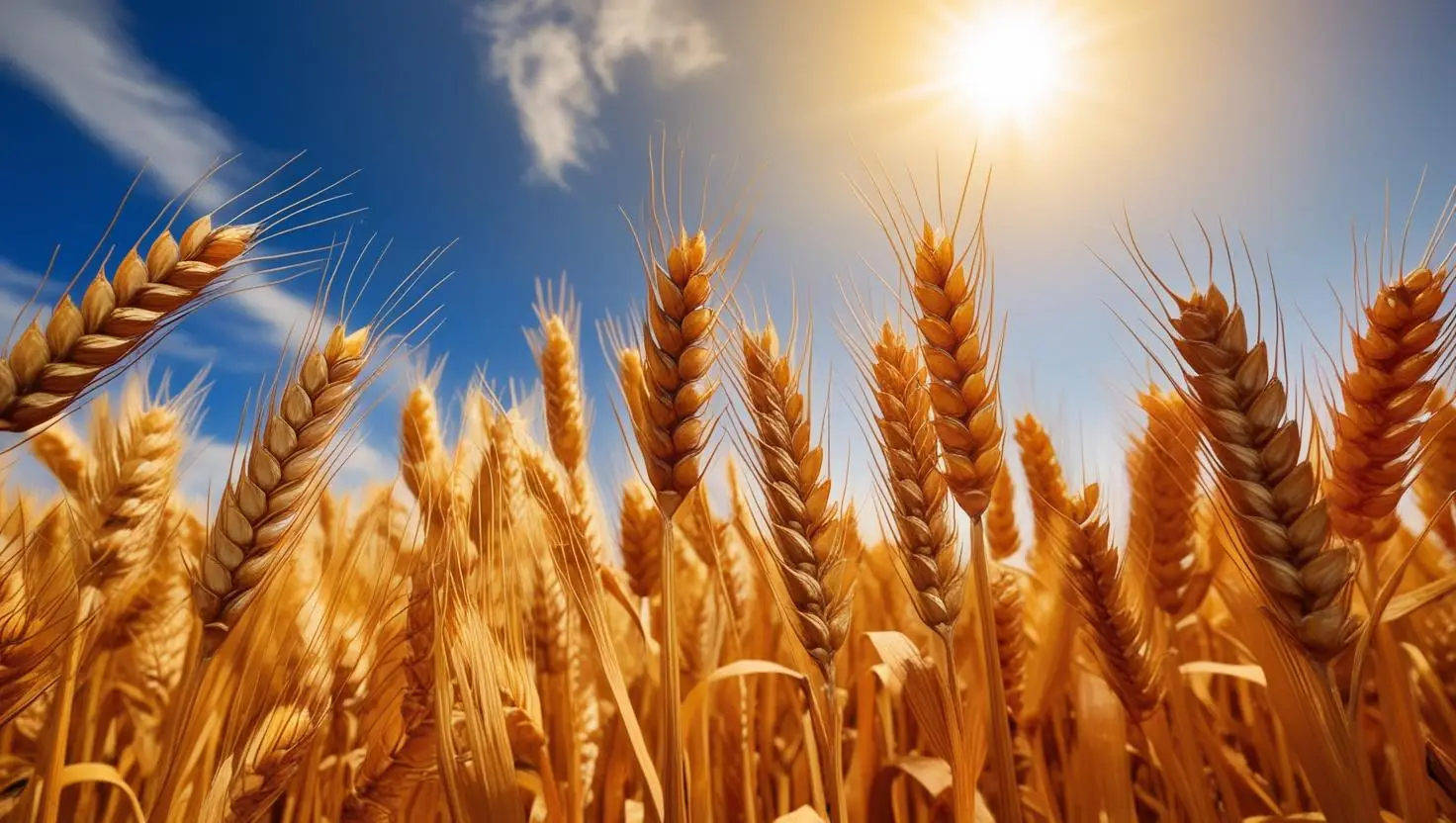
Greetings! As you stand on the brink of another season, I write to you with insights and guidance to help you maximise your wheat production. Wheat is not just a crop; it’s a cornerstone of our nation’s food security. With proper techniques and knowledge, you can achieve a golden harvest that benefits your family and community.
In this letter, I’ll walk you through crucial aspects of wheat cultivation, including climate conditions, best practices for sowing, irrigation schedules, fertilisation, and more. By following these guidelines, I hope you can optimise your efforts and witness a bountiful yield.

Wheat: An Introduction
Wheat (Triticum aestivum) is the second most important cereal crop in India, following rice. It plays a crucial role in the food and nutritional security of our country, providing about 20% of the calories consumed by nearly 55% of the world’s population. In India, wheat is a staple food, especially in North India where chapatti is a dietary staple.
India supports the cultivation of three types of wheat: bread wheat, durum wheat, and dicoccum wheat. Among these, bread wheat is the most widely cultivated, contributing approximately 95% of the total wheat production. The cultivation of wheat in India is spread across six agro-climatic zones, with the Indo-Gangetic Plains being the primary wheat-producing region.
Understanding Climate and Production Conditions
Wheat thrives in a variety of climatic conditions, but understanding your local environment is key to success. For those farming in the Northern Hills Zone of India, where the climate can be unpredictable, you may face challenges like low temperatures early in the season, high temperatures during reproductive stages, and sporadic droughts.
In this region, wheat is typically grown on small terraces and valleys, with sowing beginning in October-November and harvesting in May-June. However, in higher altitudes, where winters are harsh, wheat is cultivated in summer between May and September. The temperate climate and longer growing seasons offer the potential for higher yields, provided you choose the right varieties and practices.
Varietal Selection: Choosing the Right Wheat
The selection of wheat varieties plays a crucial role in ensuring a good yield. Traditional farmers’ varieties, though tall and hardy, often suffer from low productivity and susceptibility to diseases like rust. Instead, I encourage you to adopt high-yielding, semi-dwarf varieties that have been specially developed for the Northern Hills Zone.
For example, varieties like ‘VL Gehun 616’, ‘HS 507’, and ‘HPW 251’ are tailored to specific conditions, whether early-sown rainfed fields or late-sown irrigated lands. These varieties are not only resistant to rust and smuts but also offer higher productivity.
Bread Wheat Varieties: These are suitable for the Northern Plains, offering high yield and resistance to rust diseases.
Durum Wheat Varieties: Ideal for the Central Zone, these varieties are known for their drought tolerance and suitability for pasta production.
Dicoccum Wheat Varieties: Grown in the Peninsular Zone, these are preferred for their nutritional value.
Preparing the Field: Foundation for a Healthy Crop
A well-prepared field is the bedrock of successful wheat cultivation. Wheat requires finely pulverized, clod-free soil to ensure uniform germination and plant growth. In rainfed areas, special care must be taken to conserve soil moisture during field preparation.
For best results, I recommend ploughing the field in the evening and leaving the furrows open overnight to absorb moisture from the dew. The final ploughing should be followed by planking in the morning to seal in moisture. This approach is particularly crucial in rainfed regions, where every drop of moisture counts.
Sowing Techniques: Setting the Stage for Growth
While traditional broadcasting methods are still common, they lead to uneven germination and higher seed rates. Instead, drilling with a seed-cum-fertilizer drill is the optimal method. This technique ensures that seeds are sown at the correct depth and spacing, leading to uniform growth and a strong crop stand.
The depth of sowing is critical—high-yielding dwarf varieties should be sown at a depth of about 5 cm. If seeds are sown too deep, germination is delayed, and if sown too shallow, they may not get enough moisture. For early and timely sown crops, maintain a row spacing of 20 cm, while late-sown crops should be spaced closer at 15-18 cm.
Irrigation: Quenching Your Crop’s Thirst
Proper irrigation is vital for achieving a high yield. For wheat, I recommend 4-5 irrigations throughout the season, excluding pre-sowing irrigation. The most critical stage for irrigation is the Crown Root Initiation (CRI), which occurs 30-35 days after sowing.
Following CRI, additional irrigations should be applied at late tillering, booting, and milk stages. For efficient water use, the border method of surface irrigation is ideal, as it ensures uniform water distribution and minimizes wastage.
Fertilizer Management: Nourishing Your Crop
Fertilizer management is another cornerstone of wheat production. Depending on whether your field is irrigated or rainfed, the nutrient requirements will differ. Under irrigated conditions, nitrogen should be applied in two splits—half at sowing and half at the first irrigation. In rainfed conditions, apply the full dose of nitrogen before sowing.
For phosphorus and potash, full quantities should be placed 3-5 cm below the seed at sowing. This placement ensures that nutrients are readily available to the young seedlings, supporting healthy growth.
Weed Management: Protecting Your Wheat
Weeds can significantly impact wheat yields by competing for nutrients and water. Both dicot and monocot weeds are common in wheat fields, and effective weed management is essential.
In rainfed conditions, mechanical weeding at 30-35 days after sowing is recommended, as it also helps conserve moisture. In irrigated fields, chemical weed control is more effective. Pre-emergence application of pendimethalin at 1.0-1.5 kg a.i./ha provides broad-spectrum weed control. For more complex weed infestations, post-emergence application of a mixture of isoproturon and 2,4-D or sulfosulfuron and metsulfuron is advisable.
Disease and Pest Management: Keeping Your Crop Healthy
Diseases like rust, smut, and mildew are significant threats to wheat crops, especially in the Northern Hills Zone. To manage these, choosing resistant varieties is the first line of defence. Additionally, regular monitoring and timely application of fungicides can help control outbreaks.
For instance, powdery mildew can be controlled by spraying sulfur fungicides, while smuts can be managed through seed treatment before sowing. Remember, preventive measures are always more effective and less costly than reactive treatments.
- Rust (Yellow, Brown, Black): Use resistant varieties and apply fungicides like Propiconazole at the onset of the disease.
- Blight and Mildew: Adopt cultural practices like crop rotation and use of disease-free seeds. Apply appropriate fungicides as a preventive measure.
- Aphids: Monitor the crop regularly and spray insecticides like Imidacloprid when infestation levels reach the economic threshold.
- Termites: Apply Chlorpyrifos in the soil during sowing to protect the crop from termite damage.
New Production Technologies for Resource Conservation
With the growing need to conserve resources and ensure sustainable agriculture, several new technologies have been developed:
- Laser Land Leveling: This technology helps in leveling the land, ensuring uniform water distribution and improving irrigation efficiency.
- Zero Tillage: By eliminating the need for tillage, this technique conserves soil moisture and reduces the cost of cultivation.
- Rotary Tillage: This is an effective method for managing crop residues and preparing the soil for sowing without the need for conventional tillage.
- Bed Planting: This method allows for better water management and reduces lodging, making it ideal for wheat cultivation in areas with high rainfall.
- Seeding into Loose Residues: This technique is beneficial in conserving soil moisture and organic matter by leaving crop residues on the field surface.
Harvesting, Threshing, and Storage
Timely and proper harvesting is crucial to prevent losses and ensure good grain quality. Here are some guidelines:
- Harvesting: Harvest the wheat crop when it reaches full maturity, indicated by the hard dough stage of the grain and the yellowing of the leaves. Delayed harvesting can lead to shattering and yield loss.
- Threshing: Use a mechanical thresher for efficient and quick threshing. Ensure the grain is thoroughly dried before storage to prevent spoilage.
- Storage: Store the threshed grain in a clean, dry, and well-ventilated storage facility. Use neem leaves or chemical protectants to prevent insect infestations.
Conclusion: Your Path to a Golden Harvest
Dear farmers, wheat production is a journey that requires careful planning, timely actions, and informed decisions. By understanding the unique challenges of your environment and adopting the best practices outlined in this letter, you can significantly enhance your wheat yields. The knowledge shared here is a culmination of research and practical experience aimed at empowering you to achieve the best possible outcomes.
As you prepare for the upcoming season, remember that every step you take brings you closer to a golden harvest.
Wishing you a bountiful and prosperous wheat harvest! For further assistance or any queries, please feel free to reach out to your local agricultural experts @ Agrigo 24/7
Leave a Reply