
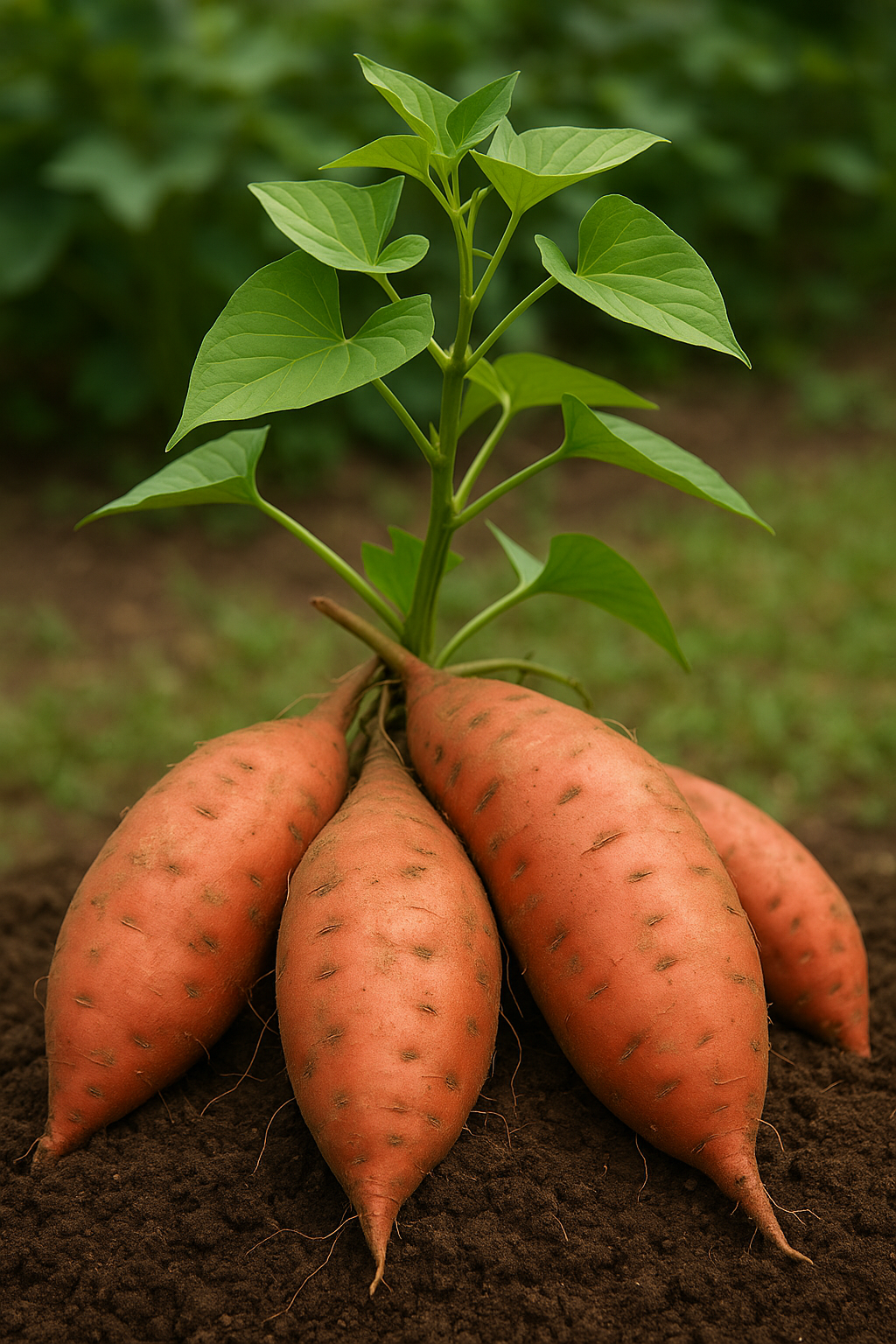
Sweet potato (Ipomoea batatas) is a popular crop cultivated for its sweet, starchy roots. Its tubers are not only a delicious food source but also highly nutritious, particularly rich in beta-carotene, making them a powerful antioxidant. This crop is vital in several countries, especially in tropical regions like India, where it is grown extensively for its ability to thrive in diverse conditions. Sweet potatoes are versatile in their culinary use, and their high productivity makes them a staple in many regions.
Sweet potato is an herbaceous perennial vine with heart-shaped or lobed leaves. The tubers, which are the main edible part, come in a variety of colours, with skins ranging from purple to brown or white, and flesh colours varying from yellow, orange, and white to purple. In India, around 2 lakh hectares are under sweet potato cultivation, with Bihar, West Bengal, Uttar Pradesh, and Odisha being the primary production states.

Climatic Conditions and Soil Requirements
Sweet potato thrives in tropical to subtropical climates, where temperatures range between 26-30°C. It also requires moderate rainfall, between 750-1200mm annually, to ensure optimal growth and tuber formation. Sweet potato is particularly well-suited to sandy loam soils, which offer excellent drainage and sufficient fertility. While the crop can tolerate various soil types, it should not be planted in very light sandy soils or heavy clay soils as these conditions can impede tuber development. The ideal pH range for sweet potato cultivation is between 5.8 and 6.7, promoting healthy root growth and nutrient uptake.
Popular Varieties and Yield Potential
Sweet potato varieties differ widely based on regional and environmental suitability. Here are some of the most popular and high-yielding varieties cultivated across India:
- Punjab Sweet Potato-21: This variety has medium-long vines with broad, dark green leaves. The vines are 4.5 cm long, with a 9 cm petiole length. The tubers are deep red with white flesh, typically 20 cm long and 4 cm wide, and weighing around 75 grams. This variety matures in approximately 145 days, producing an average yield of 75 quintals per acre.
- Varsha: Recommended for cultivation in Maharashtra, this variety performs best during the rainy season and produces an average yield of 62.5 quintals per acre.
- Konkan Ashwini: Another variety developed for Maharashtra, Konkan Ashwini is known for its short growth duration and high yield potential.
- Sree Arun: This early-maturing variety is developed by the Central Tuber Crop Research Institute (CTCRI) in Sreekariyam. Its tubers have pink skin with cream-coloured flesh, and the variety yields between 83-116 quintals per acre.
- Sree Kanaka: Also developed by CTCRI, this variety has cream-coloured skin with dark orange flesh. It offers an average yield of 41-62.5 quintals per acre.
- Sree Varun: A cream-coloured tuber variety, Sree Varun matures within 90-100 days and yields between 80-110 quintals per acre.
Improved Varieties: High-yielding, disease-resistant varieties like H-41, H-42, Co 3, Co CIP 1, Sree Vardhini, Sree Rethna, Sree Bhadra, Sree Nandini, Kanjanghad, Gouri, Sankar, and Kiran are also popular choices for farmers across India.
Land Preparation
To ensure the best results from sweet potato cultivation, proper land preparation is essential. The soil should be thoroughly tilled to a fine tilth by ploughing the field 3-4 times, followed by planking to break up large clods. This ensures the soil is aerated and free of weeds, creating an ideal environment for tuber formation and growth.
Sowing Methods and Seed Treatment
Sweet potato is primarily propagated through vine cuttings, although tuber propagation can also be used. For the vine-cutting method, vines from previous crops are planted in nursery beds to develop into new plants. Terminal cuttings with at least four nodes provide the best growth results. Before planting, it is beneficial to treat the cuttings with DDT 50% solution for 8-10 minutes to prevent pest infestations. Vines are planted on ridges or flat beds at a spacing of 60 cm between rows and 30 cm between plants. Tubers are planted at a depth of 20-25 cm.
Seed Rate
To plant one acre of sweet potato, approximately 25,000-30,000 vine cuttings are required. For tuber propagation, 35-40 kg of tubers are sown in a half-kanal nursery bed from February to March, after which the vines are transplanted to the main field.
Seed Treatment
Tubers should be treated before sowing to ensure they are free from disease. One method is to soak them in concentrated sulfuric acid for 10-40 minutes before planting.
Crop Rotation
Sweet potato performs well in crop rotation systems, particularly when rotated with rice. This method is especially effective in irrigated areas. After harvesting the second crop of rice in December or January, sweet potatoes can be planted to make efficient use of the land.
Fertilizer Management
Proper fertilization is critical for maximizing sweet potato yields. Farmers should apply a combination of organic and chemical fertilizers:
- Farmyard Manure (FYM): Apply 100 quintals per acre to improve soil structure and enhance nutrient availability.
- Chemical Fertilizers: For best results, apply:
- Nitrogen (N): 30 kg/acre, split into two applications—half at planting and half five weeks later.
- Phosphorus (P₂O₅): 25 kg/acre, applied at the time of planting.
- Potassium (K₂O): 20 kg/acre, also applied at planting.
Fertilizer doses can also be delivered in the form of Calcium Ammonium Nitrate (CAN) at 125 kg/acre, Single Super Phosphate (SSP) at 155 kg/acre, and Muriate of Potash (MOP) at 35 kg/acre. Full doses of potassium and phosphorus should be applied at planting, while nitrogen is applied in two splits for best results.
Weed Control
Weeds can quickly overrun sweet potato fields if not managed early. Pre-emergent herbicides like Metribuzine 70WP at 200g/acre or Alachlor at 2 litres/acre should be applied before the tubers sprout. If weeds become established after sprouting begins, Paraquat can be used at a rate of 500-750 ml per acre to control them.
Irrigation
Sweet potato requires consistent irrigation to promote healthy growth. After planting, irrigate the field every two days for the first 10 days. Following this period, irrigation should be applied every 7-10 days. To prevent damage to the tubers, irrigation should be stopped three weeks before harvesting. However, a final irrigation two days before harvesting will make it easier to lift the tubers from the soil.
Pest and Disease Management
Sweet potato crops are vulnerable to various pests and diseases, but with proper management, farmers can minimize damage.
Common Diseases:
- Black Scarf: This disease appears as black specks on tubers and can cause the plant to dry out. It is essential to use disease-free tubers for planting and treat seeds with Mercury before sowing. Crop rotation and keeping the land fallow for two years can also reduce disease incidence.
- Early Blight: Caused by a soil-borne fungus, early blight results in necrotic spots on lower leaves. Mancozeb or Copper Oxychloride sprays (30g/10L water) at 45 days can help control its spread.
- Common Scab: This disease affects both field and storage conditions, causing brown lesions on the tubers. Farmers should avoid deep planting and use well-rotted cow dung in the field. Seed treatment with Emisan 6 (0.25%) can also reduce the risk of infection.
Pests:
- Sweet Potato Weevils: These pests damage the crop by feeding on the epidermis of vines and leaves. Spray Rogor (200ml/150L water) per acre to control the infestation.
- Tuber Moth: Active both in the field and during storage, tuber moths tunnel through the tubers. Carbaryl (400g/100L water) spray can control this pest.
- Aphids: Aphids suck plant sap, causing deformation of young leaves. Imidacloprid (50ml/150L water) or Thiamethoxam (40g/150L water) sprays can prevent their damage.
Harvesting and Post-Harvest Care
Sweet potatoes are typically ready for harvest 120 days after planting. The best indicator of maturity is when the leaves turn yellow. The tubers should be harvested by carefully digging them out to avoid damage. On average, farmers can expect a yield of 100 quintals per acre.
After harvesting, the tubers should be cured by placing them in a warm, well-ventilated area. This process allows the skin to thicken and heal minor injuries, extending its shelf life and improving its marketability.
Conclusion
Sweet potato is a highly nutritious and versatile crop with great potential for both small-scale and commercial farmers. By following the recommended practices for land preparation, sowing, fertilization, irrigation, and pest control, farmers can achieve high yields and excellent quality tubers. Sweet potato cultivation not only provides substantial economic returns but also contributes to food security and nutrition across the globe. With its resilience and adaptability, the crop continues to be an invaluable resource in the agricultural landscape of India and beyond.
Reference
http://www.agritech.tnau.ac.in/horticulture/horti_vegetables_sweet%20potato.html
https://www.apnikheti.com/en/pn/agriculture/horticulture/vegetable-crops/sweet-potato
https://epubs.icar.org.in/index.php/AAR/article/download/55569/23316/137862
Connect with Us.
Wishing you a bountiful and prosperous Sweet Potato harvest! For further assistance or any queries E-mail us, please feel free to reach out to your local agricultural experts @ Agrigo 24/7
Leave a Reply